
PROFESSIONAL ASSOCIATIONS & AWARDING BODIES
Deliver assessment programs with confidence
Verify candidate identity, maintain consistent standards, and support fair, defensible decisions across every provider, location, and testing session.
- BUILT FOR PROGRAM TRUST
The trust behind every designation starts with every assessment
Professional associations and awarding bodies protect the credibility of the professions they serve. Every assessment decision and certification reflects the standards your organization has carefully built.
Integrity Advocate helps you deliver fair, consistent, and defensible assessment programs that strengthen confidence among candidates, employers, and the industries that rely on your certifications.
WHO WE SUPPORT
Built for the programs that define professional standards
Whether you're certifying professionals, delivering qualifications, or overseeing assessments across multiple providers, Integrity Advocate helps you maintain fair, consistent, and defensible assessment programs.
Professional certification programs
Deliver trusted assessments that support respected professional designations.
Vocational & qualification programs
Maintain consistent standards across vocational, technical, and industry qualification programs.
Continuing education programs
Verify participation and protect the integrity of assessments tied to continuing education and professional learning.
Workforce & industry training programs
Support secure assessments that verify competency before employees enter the workplace or advance their careers.
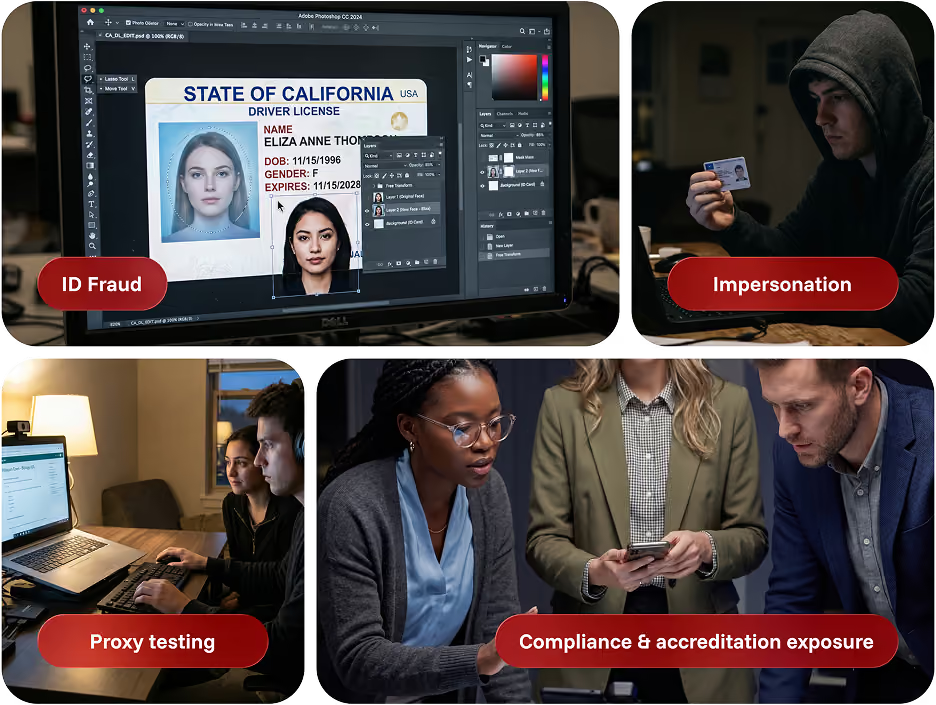
WHAT'S AT RISK
When assessment integrity is compromised, your reputation is too
As AI-assisted cheating, impersonation, and organized fraud become more sophisticated, protecting the credibility of your assessment program has never been more important.
Every compromised assessment has the potential to erode confidence among candidates, employers, and the industries you serve.
WHY INTEGRITY ADVOCATE
Built for modern assessment programs
Professional associations need more than a proctoring platform. They need an assessment partner that protects program integrity while delivering a positive experience for candidates, administrators, and reviewers alike.
Every identity check, AI flag, and assessment outcome is reviewed by a trained specialist, helping ensure fair, consistent, and defensible decisions.
Candidates launch directly from their browser with no downloads, extensions, or complicated setup, reducing support requests and improving accessibility.
Choose the level of identity verification and assessment monitoring that fits each program, from low-stakes continuing education to high-stakes certification exams.
Every assessment includes detailed records, timestamps, and evidence to support appeals, accreditation reviews, and quality assurance processes.

Defensible assessment process
Built to support every stage of a trusted assessment program
Integrity Advocate helps organizations at each stage of the assessment process so results can be trusted long after testing is complete.

DEFENSIBLE BY DESIGN
Every assessment decision should stand up to scrutiny
Professional associations protect the standards of an entire profession. Every result should be backed by documented evidence, consistent review, and a clear record your organization can confidently defend.
Integrity Advocate combines identity verification, AI-assisted detection, and every result is Verified by Human Review™ to help ensure assessment decisions are fair, consistent, and supported by evidence.
WHAT OUR CLIENTS SAY
"We were able to scale that up dramatically through our move to D2L Brightspace and the integration with Integrity Advocate. There was a point at which we maybe had a few thousand students being e-proctored, to the point now where every one of our students is e-proctored through the payroll compliance professional designation... And that ramp-up happened in less than three months."

CUSTOMER STORY
See how the National Payroll Institute modernized assessment delivery while strengthening trust
Supporting 16,000 course enrollments and 30,000+ exam sessions annually, the National Payroll Institute needed a modern assessment experience that protected its payroll designations without adding friction.
With Integrity Advocate, it reduced academic integrity incidents by 57%, nearly eliminated technical issues, and now resolves assessment reviews in 48 hours instead of weeks.
ADDITIONAL RESOURCES
Insights for modern assessment programs
Explore articles, case studies, and resources to help you strengthen assessment integrity, improve candidate experience, and protect the value of your certifications.
Key Takeaways from ASAE Annual 2026 | What Indianapolis Told Us About the Future of Association Learning
August 21, 2026
|
5 min read
At ASAE Annual, it was clear that continuing education has become a strategic driver of member value, revenue, and reputation. As associations scale learning online, verification and assessment integrity are essential to ensuring every credential remains credible and meaningful.
I just got back from ASAE's Annual Meeting in Indianapolis, and I'm still working through everything I heard. If you've never been, ASAE Annual is the biggest gathering of association executives in the country, and this year's theme was Driven by Purpose. That framing turned out to fit the week better than I expected, because the show floor and the session rooms were both buzzing with the same underlying question: what does it actually mean to serve your members well right now?
I went in expecting to hear a lot about membership growth and event strategy. I came home with something different. Almost every conversation I had, whether it was in a session, at a sponsor booth, or over coffee between keynotes, eventually circled back to learning. Specifically, how associations build it, how they prove it works, and how they protect it once it's out in the world.

1. Continuing education isn't the "informal" side of the business anymore
For a long time, a lot of associations treated their learning and CE offerings as a member benefit that lived somewhat separately from the core business. Nice to have, good for retention, not exactly mission-critical. That framing is gone.
What I heard over and over in Indianapolis is that association leaders now think about learning the way they think about credentialing: as a structured, accountable framework, not a loose collection of webinars and one-off workshops. IACET came up constantly, and for good reason. Getting IACET accredited and issuing verifiable CEUs isn't a box to check anymore, it's how associations signal that their education actually meets a recognized standard. That shift, from informal to formal, from "nice to have" to genuinely important, is probably the single biggest theme I took away from the whole week.
2. Formal CE training has real, measurable value, and associations are done treating it as an afterthought
Related to that first point: I sat in on more than one session where association leaders talked about the actual return on investing in properly structured continuing education. It's not just about compliance or member satisfaction scores. Strong CE programs are becoming a genuine revenue line and a genuine reputational asset. Members are willing to pay for training they trust. Employers are willing to sponsor it. Regulators and licensing bodies are willing to recognize it. But none of that works if the learning underneath it is soft. The associations getting this right are the ones investing in real instructional design, real assessment, and real verification, not just slapping a certificate on the end of a video.
3. Relevance is out. Impact is what associations are actually chasing now
This was the idea that really took some time to realize, and it came from a presentation from Bill Sheehan, Global Head of Association Strategy at D2L. Bill put it something like this: associations are no longer striving just to be relevant, they need to strive to provide impact.
At first that sounds like a subtle rewording. It isn't. Relevance is a passive approach. It's about staying in the conversation. Impact is active, and it cuts both ways. I think the important thing about this point was that impact can be positive or negative, and a lot of associations aren't accounting for the downside risk. If your learning programs are weak, if credentials can be gamed, if there's no way to verify who actually did the work, you're not just failing to be relevant. You're actively creating negative impact and negative relevance in your market. The flip side is just as true. When an association has a learning program that's genuinely strong, genuinely verified, and backed by a track record of real outcomes, that reputation compounds. It becomes a reason members join, a reason employers recognize the credential, and a reason the association keeps mattering long after "staying relevant" would have run its course.
That distinction reframed a lot of what I heard for the rest of the conference. Every session about member engagement, every booth conversation about growth, all of it came back to whether the learning experience behind the association's brand could hold up to scrutiny.
4. Association leaders care deeply about their members, and that's exactly why this matters
I want to name something that came through clearly in every room I sat in: the people running these associations are not thinking about learning as an abstract strategy exercise. They're thinking about their members as real people trying to advance their careers, keep their licenses current, and get genuine value out of their membership dollars. That care is what's driving the push toward more formal, more rigorous learning programs in the first place. Leaders don't want to hand their members a credential that doesn't mean anything. They want to hand them something that actually opens doors and helps them create career impact.
5. No association can scale that impact alone, and that's exposing some hard problems
The tension nobody can avoid: every association I talked to wants to build stronger, more credible learning programs, and almost none of them have the internal edtech capacity to do it at scale by themselves. That's where the partnership conversations came in, again and again. Associations know they need help from learning platforms, assessment tools, and credentialing technology to reach more members without diluting quality.
But moving all of this online, at scale, has created new problems that didn't exist when these programs meant a room full of people and a sign-in sheet. Fake learners. Shared logins. Credentials issued to someone who never actually did the work. Once a program moves online, the question stops being "is our content good" and becomes "can we actually prove who earned this." That's a hard problem, and it's one that's only getting more visible as more learning moves off the conference room floor and onto a screen.
Where this leaves associations
Walking away from Indianapolis, the thread connecting all of this was pretty clear to me, and it kept circling back to that "Driven by Purpose" theme. Purpose isn't a slogan on a conference banner. It's the reason associations are building real, structured, IACET-aligned learning programs in the first place. They care about their members and they know relevance alone isn't enough anymore. But that same shift toward formal, high-stakes learning is exactly what makes verification and integrity non-negotiable. A credential is only as good as the association's ability to stand behind it, and that means knowing, with confidence, that the person on the other side of the screen is who they say they are and did the work they're claiming credit for.
That's the piece we spend our time on at Integrity Advocate, and it's why conversations like this one always feel personal to me. If your association is investing in building the kind of learning program Bill Sheehan was describing, one that creates real impact instead of just chasing relevance, let's talk about how to protect it. Book a demo with our team and we'll walk you through how we help associations secure their learning programs, verify real learners, and make sure every credential you issue actually means something.
{{post-cta}}

Case Study: How AIM Group Brought Ofqual-Regulated Assessments Online
January 25, 2026
|
5 min read
AIM Qualifications and Assessment Group, a leading UK Awarding Organisation, recognized that online assessments would soon become the default, but needed a solution that met Ofqual's strict regulatory standards without adding complexity for learners or administrators. AIM partnered with Coelrind and Integrity Advocate to build a seamless, fully compliant remote assessment system that works on any device, requires no installations, and upholds exam integrity across multiple UK testing centres.
Digital transformation in assessment isn't as simple as swapping a classroom for a video call. It requires purpose-built technology and strong partnerships to get it right. AIM Qualifications and Assessment Group, a leading UK Awarding Organisation, recognized that online assessments would soon become the norm, but needed a solution that met Ofqual's strict standards without adding complexity for learners or administrators.
{{post-block-quote}}
Key Outcomes
- Full regulatory compliance and alignment with Ofqual's assessment standards
- Seamless accessibility with no plug-ins or installations required
- Mobile-friendly and user-focused, working on any device
- Scalable and cost-effective across multiple UK testing centres
- Minimized technical issues through pre-exam system checks and clear instructions
Challenge
Bringing regulated assessments online comes with high stakes. Security, compliance, and accessibility all need to align without creating unnecessary barriers for test-takers. AIM Group needed a solution that upheld assessment integrity while making the process seamless for learners and administrators alike.
In-person exams were costly and difficult to scale, requiring dedicated invigilators and significant administrative overhead. Most proctoring tools on the market weren't flexible enough, many required plug-ins, lacked tablet compatibility, and introduced unnecessary hurdles for learners. And compliance was critical: every assessment had to meet strict integrity standards to ensure qualifications remained credible in a digital format.
"We were addressing two very specific issues, the tablet issue and the plug-in issue, which were making it impossible to bring one of AIM's largest clients onboard," said John O'Sullivan of Coelrind.
Why Compliance Matters
As an Ofqual-regulated Awarding Organisation, AIM Group must meet the Office of Qualifications and Examinations Regulation's high standards for fairness and security, whether assessments are delivered in person or online. That meant adhering to evolving guidelines covering the responsible use of AI in assessment security, strict invigilation requirements to prevent misconduct, and technical standards ensuring online exams remain as rigorous as traditional assessments.
Solution
AIM Group worked with Coelrind and Integrity Advocate to tailor a remote assessment system that removed technical barriers while ensuring exam integrity. Coelrind provided the technical foundation through its learning and assessment platform, enabling AIM Group to manage exam delivery across multiple testing centres. Integrity Advocate ensured security and compliance with a no-install, mobile-friendly proctoring solution aligned with Ofqual's regulations. User experience remained a top priority throughout, with built-in system checks, clear instructions, and cross-device accessibility ensuring every learner could complete their exam without frustration.
"The main goal was to make this user-friendly, for the end users... to make sure that when they get to the live exam, it all works swimmingly," Bailey said.
Results
Now fully implemented, AIM Group's system has transformed assessment delivery. "It all seems to be working well. Everyone's got a great new asset to support their learners with," Bailey said.
"Integrity Advocate is really easy to work with, really fun to work with and very responsive," Bailey added. "There's always a quick turnaround for change requests; they've kept us updated with their progress. I would recommend them 100%."
AIM Group's experience highlights the complexity of getting online assessment right, especially when working with regulated qualifications. With the right technology and strong partnerships, it's possible to deliver a solution that's easy to use, cost-effective, and puts learners first.
{{post-cta}}

Case Study: How the National Payroll Institute Cut Integrity Incidents in Half
July 24, 2026
|
5 min read
When the National Payroll Institute (NPI) moved its Payroll Compliance Professional and Payroll Leadership Professional designations online, its first proctoring solution created more problems than it solved. After switching to Integrity Advocate, NPI proctored more than 30,000 exams with fewer than 1% of users requiring support, cut academic integrity incidents from an average of 86 per month to 37, and reduced incident review time from weeks to 48 hours.
The National Payroll Institute issues two professional designations, the Payroll Compliance Professional and the Payroll Leadership Professional, held today by more than 21,000 members. Integrity is one of NPI's four core values, so when the COVID-19 pandemic forced a rapid shift away from honor-based, supervisor-led proctoring, NPI needed an online solution that could uphold that standard at scale.
Key Outcomes
- 57% reduction in academic integrity incidents, from an average of 86 per month down to 37
- Fewer than 1% of users require technical support
- More than 30,000 exams proctored with a seamless experience
Challenge
NPI's first attempt at online proctoring didn't hold up. The system required plugin downloads, ran on a limited set of browsers, and offered no French-language support for the 12% of NPI's membership that operates in French. Close to half of students hit a technical issue during their exam. For a body responsible for validating the competency of more than 17,000 PCP and 4,000 PLP designation holders, that wasn't a minor inconvenience. It was a threat to the credibility of the credential itself.
{{post-block-quote}}
A Complete Transformation in User Experience
After switching to Integrity Advocate, the technical support burden that used to consume staff time became close to invisible. Integration with NPI's D2L Brightspace LMS meant students could move directly from coursework into a proctored exam without separate logins or downloads, and the entire implementation took a single 45-minute setup meeting, compared to weeks of troubleshooting under the previous system.
"We're getting very little feedback," Pacella said. "And that's amazing. That speaks volumes. That's exactly what we want. You don't hear about software that works well typically... But if it didn't work, you better believe we're going to hear about it a lot."
Dramatic Improvement in Academic Integrity
Paired with a proactive integrity education module, NPI's average dropped from 86 incidents per month to 37, a reduction of more than half, and the improvement held steady over time.
"We went from an average of 86 incidents per month, and it dropped more than in half, down to 37," Pacella said. "And that's been very consistent since we implemented some of these resources and things for people to understand what academic integrity means."
The reduction wasn't just about fewer incidents. It was about quality. The incidents that remained were genuine violations, not technical false positives or misunderstandings about proctoring protocols. That let NPI's review committees spend their time on legitimate concerns instead of sorting through noise, producing more consistent, more defensible decisions.
Seamless Student Experience
Daniela Kwiatkowski, NPI's Manager of Learning and Professional Development, experienced the system firsthand when she took one of NPI's own courses. Her experience highlighted how the technology disappeared into the background, letting students focus on demonstrating their professional competency.
"Before you do it for the first time, you're thinking, how am I going to do this?" Kwiatkowski said. "I moved the camera to one corner and then I forgot about it, and it was easy to forget about it. It wasn't constantly there... now I could focus on the exam, which is what we want people to do."
Scaling Success Across the Organization
NPI's growth didn't stop once the technical problems were solved. According to Steven Van Alstine, Vice President of Professional Standards and Education, NPI moved from proctoring a few thousand students to e-proctoring every student pursuing the Payroll Compliance Professional designation, a ramp-up that happened in under three months.
"We were able to scale that up dramatically through our move to D2L Brightspace and the integration with Integrity Advocate," Van Alstine said. "There was a point at which we maybe had a few thousand students being e-proctored, to the point now where every one of our students is e-proctored... and that ramp-up happened in less than three months."
That rapid scaling extended across NPI's mixed delivery model, including partnerships with public and private academic institutions alongside direct-to-student programs, without requiring different standards across channels.
Administrative Efficiency and Confidence
Decision-making that previously took weeks now happens within 48 hours, with clear evidence and streamlined processes. The administrative team developed communication templates and tracking systems to ensure consistent, fair handling of every incident.
"Giving someone a zero on an exam or failing a course is a big deal," Kwiatkowski said. "I cannot emphasize it enough... Having the peace of mind to know this is an incident that was flagged for the right reasons... we are very confident that this is legitimate."
Advice for Other Organizations
NPI's guidance to other certifying bodies is straightforward: technical due diligence up front saves significant time later.
"There are a lot of products out there," Pacella said. "And you're going to reach out to them, and the sales team will talk a big game about all the wonderful things they can do. Take your time and understand the technical aspects of implementation before making a decision."
{{post-cta}}
Frequently asked questions
Find answers to the most commonly asked questions.
Protecting assessment integrity requires more than monitoring an exam. Effective programs combine identity verification, browser-based assessment security, AI-assisted detection, and verified human review to ensure assessment outcomes are fair, consistent, and supported by evidence.
Yes. Integrity Advocate supports organizations ranging from smaller certification programs to large national associations delivering thousands of assessments each year. Flexible security options allow you to apply the right level of protection based on each assessment.
Every assessment includes documented evidence, timestamps, and review records that help organizations investigate incidents, respond to appeals, and demonstrate consistent assessment practices during audits or accreditation reviews.
No. Candidates launch assessments directly from their browser without downloads or extensions, creating a simpler experience while reducing technical support requests and improving accessibility.
AI helps identify potential integrity concerns, but trained specialists review every identity check, AI flag, and assessment outcome before a final decision is made. This helps reduce false positives while providing fair, consistent, and defensible assessment results.

See how Integrity Advocate can strengthen your program
Book a 30-minute demo and we will walk through what sets Integrity Advocate apart, what it looks like for your specific program type, and how quickly you can get started.
10M+
Total sessions proctored
65+
Languages supported
98%
Client retention rate