April 7, 2026
|
8
min read
AI-Only, Live, or Hybrid: Which Proctoring Model Is Right for Your Program?
Before you compare proctoring features or pricing, the model underneath matters most. This post breaks down AI-only, live, and hybrid proctoring, where each fits, and why not all hybrid models are actually hybrid.

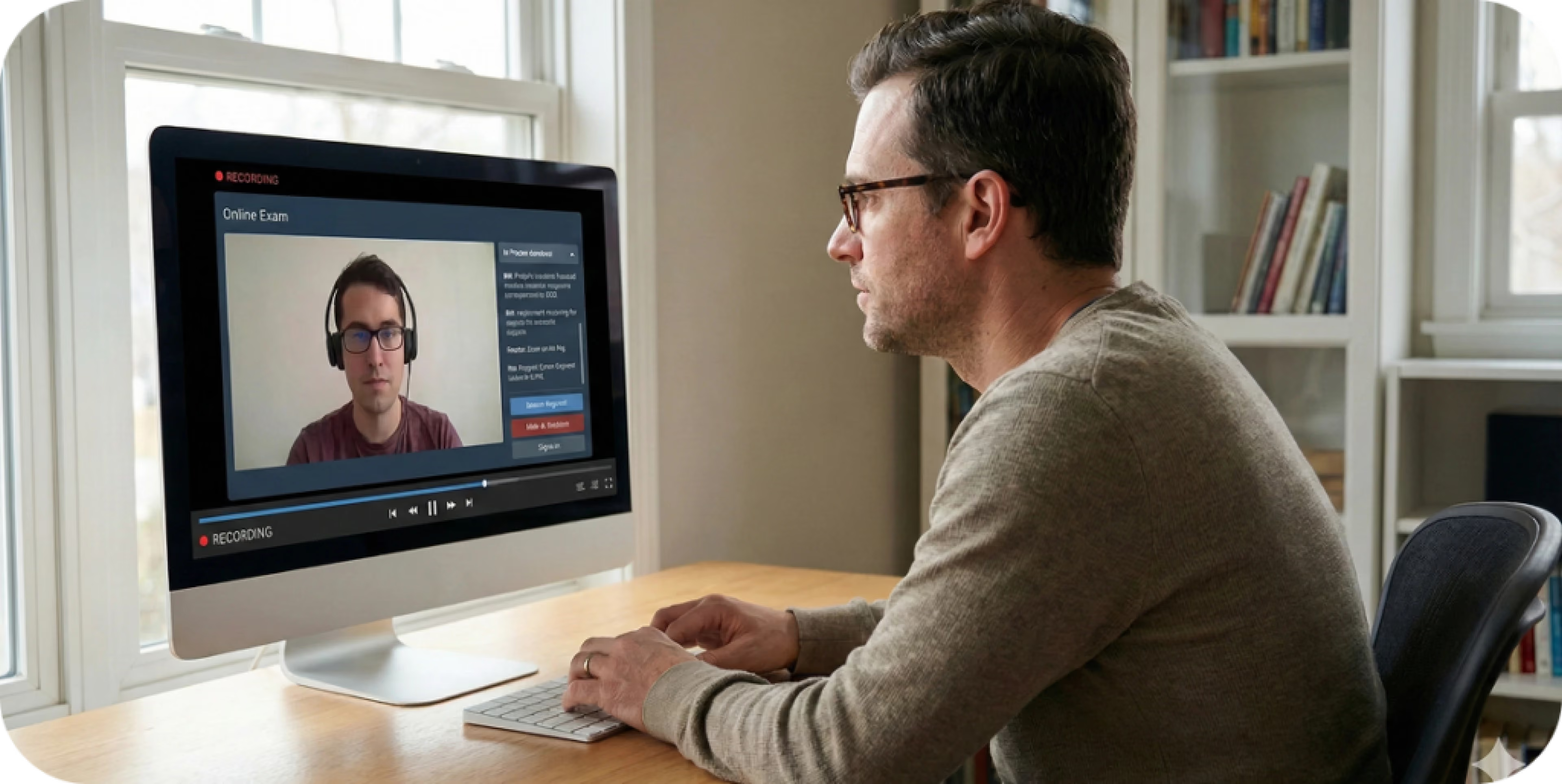
Not all proctoring tools work the same way. Before you compare features, pricing, or integrations, the most important decision is the model underneath the platform. If you get that wrong, everything else falls apart.
There are three approaches to online proctoring. Each has a legitimate use case. Each has a real trade-off. And one of them is consistently misunderstood as the safe middle ground when, in practice, not all hybrid models are equal.
As the market scales, programs are under more pressure than ever to choose the right model. Here is what each one actually means and what it means for your program.
The Three Proctoring Models
1. AI-Only Proctoring
AI-only platforms monitor sessions using algorithms. They track eye movement, audio patterns, browser behavior, and screen activity. When the system detects something outside expected parameters, it flags it. The report goes to your institution. Your team decides what to do with it.
The appeal is real. These tools are low cost, highly scalable, and require minimal vendor involvement. For programs running thousands of low-stakes assessments, that efficiency matters.
49% of students globally participated in online learning by March 2025 — driving demand for proctoring that scales without sacrificing accuracy. Source: Business Research Insights, 2026
The risk is also real. AI-only platforms typically flag 15 to 20 percent of all sessions. Many of those flags are not genuine integrity violations. Without a human reviewing the flag before it reaches your inbox, your team is doing that work. The savings on the tool often do not account for the time your staff spends sorting through incidents.
"When a result is challenged, the answer 'the algorithm flagged it' is not a defensible audit trail."
For programs where outcomes carry weight, that gap is a liability.
AI-only works when stakes are low, volume is high, and your institution has capacity to review flags internally.
2. Live Human Proctoring
Live proctoring puts a trained human proctor in the session in real time. The proctor monitors the exam as it happens, can communicate with the test taker, and can intervene if something goes wrong.
The accuracy is high. The human judgment is present. The audit trail is strong. For high-stakes licensing exams, certification bodies with regulatory requirements, and professional credentials where disputes are foreseeable, live proctoring has historically been the answer.
The trade-offs are scheduling and cost. Test takers need to book a time slot. Proctors need to be available. Per-session pricing adds up quickly at scale. For programs delivering hundreds or thousands of exams across flexible windows, the logistics become unworkable.
48% Of students expressed discomfort with webcam-based monitoring during exams — a signal that the model you choose directly affects learner trust in your program. Source: Business Research Insights survey, 2023
Live proctoring is also more intrusive for the learner. Being watched in real time creates anxiety that can affect performance. For programs that care about the experience of their test takers, that friction is worth accounting for.
Live proctoring works when stakes are high, volume is manageable, scheduling is structured, and real-time intervention is a non-negotiable requirement.
3. Hybrid Proctoring: The Model That Varies Most
Hybrid proctoring combines AI monitoring with human review. In principle, it offers the best of both approaches. In practice, it depends entirely on one question: when does the human review happen, and is it mandatory?
Many platforms that describe themselves as hybrid use AI for detection and offer human review as an optional tier or a paid escalation. That is not a genuine hybrid. It is AI-only with an appeal process.
Integrity Advocate is built on this model. Human review is not an upgrade.
Hybrid proctoring with mandatory human review delivers scale without shifting the review burden to your institution.
The Question to Ask Every Vendor
When a flag is raised, who reviews it, and when?
If the answer is your team reviews it, or a human reviews it if you escalate, you are looking at AI-only with extra steps. If the answer is our reviewers examine every flag before it becomes an outcome, you are looking at a genuine hybrid. That question takes 30 seconds and tells you more than a 90-minute demo will.
{{post-cta}}
Keep reading

AI and Online Exams: What the Data Reveals About Assessment Security
February 11, 2025
|
6
min read
Large-scale Wiley research surveying more than 2,900 students and instructors across North America reveals that cheating is measurably increasing in online environments, nearly half of students report using generative AI in their coursework, and 86% of instructors say students are more likely to cheat in online courses than in person. This post examines what the data reveals about the current academic integrity landscape, how AI has reshaped the threat model without changing the underlying intent behind misconduct, and how Integrity Advocate's COUNTER-AI approach responds to behavioral patterns rather than chasing specific tools.

Admin-Ready Results: Why Audit-Ready Reporting Matters More Than Ever in Online Proctoring
December 16, 2025
|
3
min read
For many administrators, the most time-consuming part of secure assessment delivery happens after the exam: reviewing sessions, sorting through flags, watching recordings, and trying to turn raw data into decisions the team can stand behind. Most proctoring tools generate a lot of data but very little clarity, leaving administrators to manually reconstruct context that should already be documented. This post examines what administrators actually need from proctoring reporting, why unclear results become a bottleneck as programs scale, and how audit-ready reporting shifts proctoring from a reactive process to a streamlined one.
AI Cheating Tools Are Outpacing LMS Defenses. Integrity Advocate Built a Solution
August 17, 2023
|
3
min read
GPT-powered browser plugins can now prefill answers to online exam questions the moment they appear, and LMS platforms have no effective countermeasures. Integrity Advocate's ExposeAI is a purpose-built detection capability that identifies AI-assisted cheating during assessment sessions, integrating directly into the existing monitoring suite without any client-side installation. This post explains how these tools work, why they matter for certified training programs, and how ExposeAI addresses the threat.
Frequently asked questions
Find answers to the most commonly asked questions from our clients.
Automated proctoring uses AI algorithms only. Hybrid proctoring pairs AI detection with human review. The key question is whether that human review is mandatory on every flag or only available as a paid upgrade. That distinction changes what your results are worth.
Not necessarily. Live proctoring provides real-time intervention, which is valuable for certain high-stakes contexts. But post-exam hybrid models with mandatory human review can be equally defensible and significantly more scalable. Security comes from the review process, not just who is watching.
Yes. AI-only platforms typically flag 15 to 20 percent of sessions. Without human review to filter those flags, institutions receive a high volume of incidents that require internal review. Mandatory human review reduces that burden significantly by catching false positives before they reach your team.
Every flagged session is reviewed by a trained human reviewer before any outcome is finalized. AI detects. Humans verify. Your team receives a clean, documented result. Human review is not a tier or an upgrade. It is standard on every exam, for every client.