December 18, 2025
|
5 min read
Protecting Exam-Takers and Your Reputation
Organizations administering online assessments face a dual responsibility: protect learners from unnecessary risk and protect the credibility of the programs and credentials they stand behind. These are not competing goals. They are two sides of the same decision. This post examines what learner protection actually requires in proctoring, from no-install design and privacy-first data handling to a low-friction exam experience, and what credential and reputation protection depends on, including trusted results, human-validated outcomes, and consistent, fair processes that stakeholders can rely on over time.


Online proctoring plays a bigger role than many people realize. It doesn’t just safeguard exam rules. It shapes how test takers experience high-stakes moments, and how institutions are perceived long after an assessment ends.
Organizations are facing a dual responsibility: protect learners from unnecessary risk, while protecting the credibility of the programs and credentials they stand behind.
The proctoring decisions institutions make today have a direct impact on trust, reputation, and long-term program health.
Protecting Learners
For learners, exams are already stressful. Proctoring shouldn’t add unnecessary anxiety or risk.
Unfortunately, many traditional approaches require software downloads, intrusive monitoring, unstable setups, or unclear instructions, which can make learners feel uneasy before an exam even begins. In some cases, they raise real concerns around device security, malware exposure, and privacy.
1) Protecting Devices With No-Install Proctoring
The safest exam experience is often the simplest one. When proctoring runs in the browser with no downloads or plugins, learners avoid unnecessary software installations and reduce exposure to malware or device-related risk. It also removes one of the most common points of failure at exam start, the install process itself.
2) Protecting Identity Through Privacy by Design
Protecting learners also means protecting their personal information. Privacy-first proctoring should collect only what’s necessary to verify identity and maintain integrity, and handle that information responsibly. When institutions can confidently explain what data is collected, how it’s used, and how long it’s retained, it builds trust, not just compliance. This is particularly true in advanced academic programs, where balancing assessment security and privacy programs means weighing rigor against learner trust.
3) Protecting the Experience
Even the most secure proctoring tool falls short if the experience is confusing or fragile. A seamless, low-friction flow helps learners start exams calmly and complete them without disruption. Fewer technical hurdles means fewer interruptions, fewer panicked support requests, and a more consistent experience for everyone.
When learners feel safe and supported, they’re more likely to engage calmly, comply with requirements, and complete assessments successfully.
Protecting learners isn’t just a user-experience issue. It’s a trust issue.
Modern Cheating and Fraud Put Programs at Risk
At the same time, institutions are facing more sophisticated forms of cheating and fraud.
From generative AI tools to coordinated test-taking schemes, off-screen assistance, and impersonation attempts, exam risks look very different than they did even a few years ago.
The stakes are high. When misconduct goes undetected, it doesn’t just affect individual results. It can undermine the credibility of an entire program, raise questions from accrediting bodies or employers, and expose organizations to reputational and legal risk.
This is why detection needs to evolve, without crossing the line into invasive surveillance.
Protecting Credentials and Your Reputation
Protecting learners is only one side of the equation. The other is protecting the credibility of your program, the value of your credential, and the trust others place in your assessments. Just as learner protection requires thoughtful design, reputation protection depends on three equally important factors:
1) Delivering Results You Can Trust
Reputation starts with confidence in outcomes. Programs need to know that exam results are accurate, fair, and defensible, especially when decisions carry real consequences.
By combining AI detection with human review, Integrity Advocate helps surface meaningful signals while ensuring context is applied before decisions are made. Clear, audit-ready reporting then gives administrators results they can understand, explain, and stand behind, without hours of manual review.
Trusted results reduce disputes, speed up decision-making, and reinforce confidence across stakeholders.
2) Protecting the Value of Your Credential
A credential is only as strong as the integrity behind it. When learners are properly verified and assessments are delivered fairly, organizations can be confident that credentials are earned honestly by the right individual. This reduces the risk of impersonation, fraud, and post-exam challenges, while lowering institutional liability.
Ultimately, the shared goal is simple: making sure the person behind the credential has truly earned it. That matters in real-world ways, whether it’s a healthcare worker administering the right medication, a forklift operator working safely on the job site, or a food and beverage professional serving responsibly and in compliance.
When credentials can’t be trusted, risk increases for everyone. Protecting credential value helps employers, partners, and accrediting bodies trust what a credential represents, not just today, but over time.
3) Protecting Program Reputation Over Time
Reputation is built through consistent, positive experiences. When exams run smoothly, learners feel respected, and results are handled fairly, programs benefit from stronger reviews, higher satisfaction, and increased trust. Over time, that trust fuels program growth and reinforces a reputation for doing assessment the right way.
Protecting your reputation isn’t a single moment. It’s the cumulative result of fair processes, trusted outcomes, and experiences people are willing to stand behind.
Security That Protects Both Sides
Protecting learners and protecting your reputation are not separate goals, they are two sides of the same decision. Integrity Advocate is built to do both. Our no-install, browser-based experience helps reduce device risk and exam-day friction, while privacy-first design protects learner identity and keeps data handling responsible and easy to explain.
On the integrity side, we help institutions detect cheating and fraud patterns that matter, pairing intelligent detection with human oversight so results are fair, clear, and defensible, without relying on invasive tactics.
The outcome is simple: calmer exam launches, fewer support escalations, more confident decisions, and greater trust in the credential. When the experience is respectful and the outcomes are reliable, programs earn stronger reviews, lower risk, and a reputation they can stand behind.
Schedule a Demo: Explore how Integrity Advocate delivers secure, privacy-first proctoring.
{{post-cta}}
Keep reading

AI vs. Human vs. Hybrid Proctoring: Which Model Best Protects Exam Integrity?
October 9, 2025
|
5 min read
As online testing expands across education, certification, and compliance training, the choice between AI-only, human-only, and hybrid proctoring has real consequences for exam integrity, fairness, and organizational risk. This post breaks down all three models, their pros and cons, and when each is the right fit, concluding that hybrid proctoring delivers the best combination of efficiency, accuracy, and fairness for most modern assessment environments.
The Evolving Landscape of Online Exam Security
As online testing continues to expand across education, certification, and compliance training, choosing the right proctoring model has never been more important.
AI-only tools promise automation and scalability. Human-only options offer fairness and empathy. Hybrid models combine the best of both, but which one truly protects exam integrity?
This article breaks down the three dominant proctoring approaches, their pros and cons, and what to consider when choosing the right fit for your organization.
1. AI-Only Proctoring: Fast, Scalable, and Automated, but Imperfect
AI proctoring tools use algorithms to detect suspicious behavior automatically, from unusual head movements to multiple voices or unauthorized devices.
While these systems offer speed and scalability, they also raise concerns about accuracy and bias.
Pros:
- Monitors large numbers of exams simultaneously
- Automates flagging and reporting
- Reduces administrative workload
Cons:
- High false positive rates (lighting, gaze, or accessibility issues)
- Lacks human context and judgment
- Raises data privacy and fairness concerns
AI-only systems can be efficient but risk misinterpretation, which can reduced trust among test takers.
2. Human-Only Proctoring: Fair and Contextual, but Limited in Scale
Human proctors oversee exams via live or recorded video, making real-time decisions based on context and behavior.
This model prioritizes fairness, empathy, and human oversight, but introduces scalability and scheduling challenges.
Pros:
- Accurate, contextual decision-making
- Builds trust with test takers
- Reduces false flags and misunderstandings
Cons:
- Labor-intensive and difficult to scale globally
- Higher cost per exam
- Limited flexibility for asynchronous or on-demand testing
Human-only proctoring ensures fairness but struggles to keep pace with modern testing needs.
3. Hybrid (AI + Human) Proctoring: The Best of Both Worlds
Hybrid proctoring blends automation and human oversight to deliver accuracy, fairness, and scalability.
AI handles initial detection, while human reviewers verify each flagged event before reports are finalized. This ensures efficiency without sacrificing integrity.
Pros:
- Reduces false positives with human verification
- Scales efficiently across time zones
- Protects privacy and fairness
- Provides auditable, compliant reporting
Cons:
- Requires platform integration
- May introduce slight delays in review turnaround
Hybrid proctoring creates the balance today’s organizations need, efficient technology guided by human discretion.
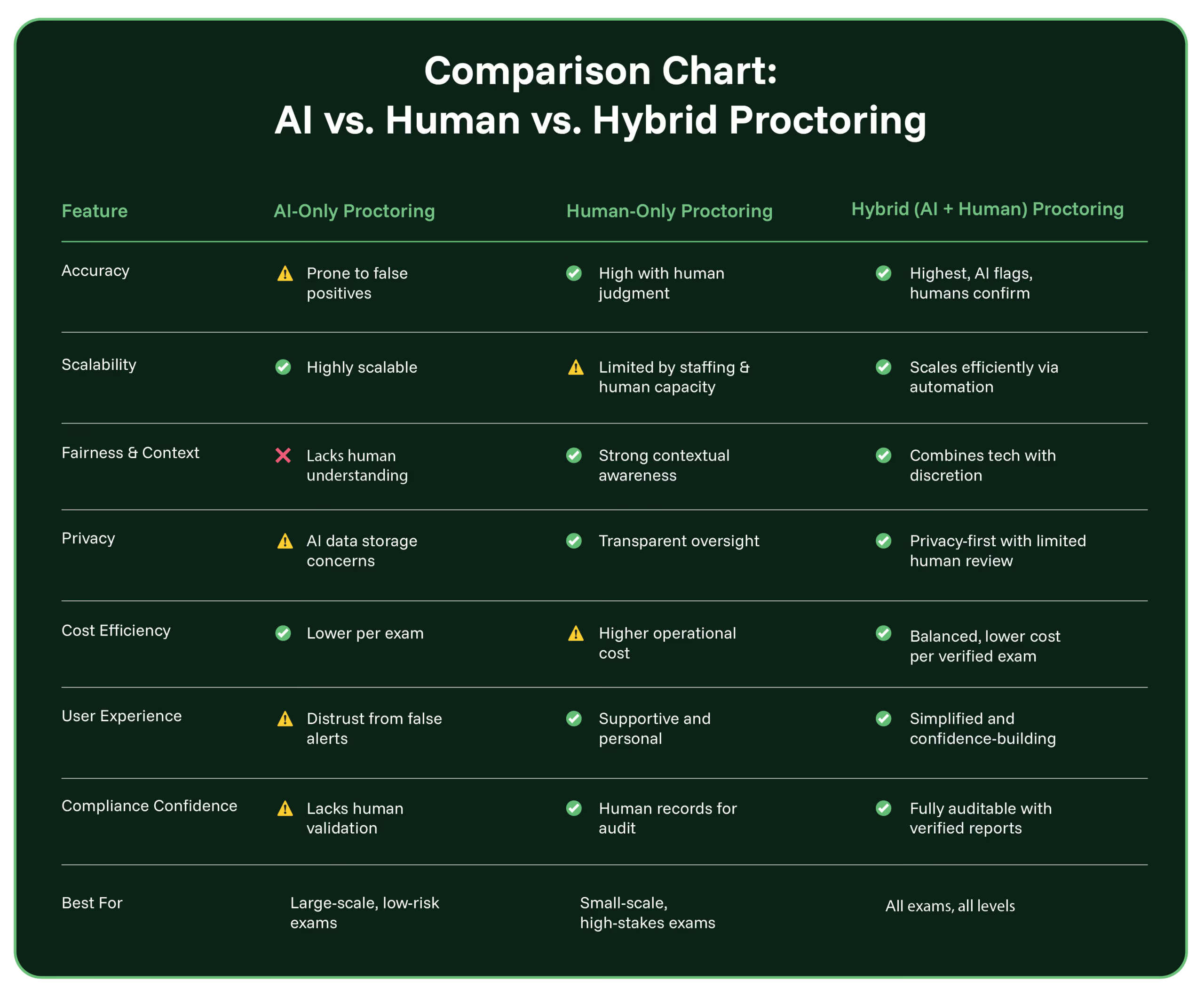
Verdict: Hybrid proctoring delivers the best combination of efficiency, accuracy, and fairness, meeting the evolving needs of modern learning and compliance environments.
When to Use Each Type of Proctoring (and When to Avoid It)
Choosing the right proctoring model isn’t just about features, it’s about fit. Here's when each approach works best, and when it might fall short.
AI-Only Proctoring
AI-only proctoring is a good fit for large-scale, low-stakes testing environments where speed and automation are priorities. It’s ideal for institutions delivering practice exams or formative assessments with minimal impact on final outcomes. If your team is constrained by staffing or budget, and real-time oversight isn’t required, AI-only can offer a fast, lightweight solution.
However, AI-only solutions are risky in high-stakes scenarios like certification, compliance, or licensure exams, especially where fairness, accessibility, and privacy are key concerns. These systems can generate false flags and lack the human context needed to distinguish genuine misconduct from harmless behavior.
Human-Only Proctoring
Human-only proctoring excels in small-group, high-stakes testing scenarios where personal interaction, empathy, and real-time judgment matter most. It's particularly useful for live, synchronous exams or specialized formats like oral exams, interviews, or hands-on assessments. If trust, fairness, and human connection are top priorities, a fully human approach ensures every test-taker is treated with context and care.
That said, this model becomes difficult to scale across large populations or global programs. It also presents challenges for asynchronous testing and tends to be more expensive due to staffing and scheduling demands. Organizations needing rapid turnaround or flexible exam windows may find this model limiting.
Hybrid Proctoring (AI + Human Review)
Hybrid proctoring combines the speed and scalability of AI with the fairness and context of human review, making it ideal for most modern assessment environments. It works especially well for mid- to high-stakes exams delivered at scale, such as workforce certification, compliance training, or higher education finals. Hybrid models support asynchronous access and bring-your-own-device testing, while still delivering human-verified, audit-ready results.
The main limitation is that some hybrid models may involve slight delays between the test and final reporting, depending on review turnaround time.
Why Hybrid Models Are the Future
Organizations are no longer choosing between technology and trust — they’re demanding both. Hybrid proctoring empowers institutions to deliver secure, privacy-compliant, and credible assessments without friction for test takers.
By combining automation and human verification, administrators get:
- Fewer false flags and student disputes
- Stronger audit trails and compliance documentation
- A smoother, more confident test-taking experience
How Integrity Advocate Sets the Standard
Integrity Advocate’s hybrid approach is designed around human-first, privacy-protected verification.
- No software installs required
- Works on any device or browser
- AI-driven detection verified by expert human reviewers
- Transparent, auditable reports administrators can trust
Integrity Advocate’s hybrid proctoring ensures fairness, compliance, and confidence in every assessment.
“Integrity Advocate integrates easily with our current system. It runs smoothly and is aesthetically pleasing; it meets the high standard we have for all our systems. It is also very effective at proctoring while not being too invasive; our users feel comfortable using it. Integrity Advocate strikes the right balance of integrity and privacy, which is hard to find!”
Ready to find the balance between automation and integrity?
Request a Demo to see how Integrity Advocate’s hybrid model redefines online exam security.
{{post-cta}}

Is Your Proctoring Solution a Security and Privacy Threat?
August 27, 2023
|
5 min read
The US Department of Education's Privacy Technical Assistance Center has documented how data breaches and malware attacks have affected education systems across every sector. Most online proctoring services require browser extensions or plugins that create exactly the kind of installation-based malware vector that security researchers flag as high risk. This post examines the threat, what organizations should require from their proctoring vendors, and why a no-installation approach eliminates the risk at the source.
The US Department of Education's Privacy Technical Assistance Center published a presentation titled Security Threats: Education Systems in the Crosshairs, in which security advisor Mike Tassey documented how data breaches, hacks, and privacy incidents have affected organizations across virtually every sector, from NASA and Citigroup to local school systems.
The warning is directly relevant to any organization using online proctoring. The data that proctoring services collect, including names, government-issued ID, biometric images, and session recordings, is exactly the kind of information that makes education systems a target.
The Threat Landscape Has Changed
Cyber-theft has become fully commoditized. There is an active black market for personal data, and an underground economy where over two million pieces of malware are built and sold every year. This malware is designed to gather precisely the kind of information proctoring platforms collect: Social Security numbers, addresses, birth dates, and identity credentials.
Tassey specifically noted that children's identities are particularly valued by data thieves because they are, in his words, fresh. A child's identity may go undetected for years before the theft is discovered, making it a high-value target for long-term fraud.
The alarming part is how malware typically gets onto devices. It is not usually through pirated software or poor security settings. It enters through plugins and browser extensions that users install themselves, often for legitimate purposes. The installation is the vector.
Why Proctoring Plugins Create Specific Risk
Most online proctoring services require users to install browser extensions or plugins to enable monitoring. Each of these installations represents an opportunity for malware to enter the device, either during the initial installation or through a subsequent update, without the user's knowledge or permission.
Tassey's research notes that on average there are one to five bugs for every 1,000 lines of code. For organizations that have not completed independent code reviews of the proctoring software they deploy, those bugs represent an unexamined attack surface. Malware can be introduced into code updates without detection, meaning a plugin that was clean at installation may not remain so.
At minimum, organizations should be instructing learners to disable or uninstall proctoring plugins and extensions immediately after use. The risk does not end when the exam does.
What a Code Review Should Cover
Organizations that require learners to install proctoring software should conduct, or require their vendor to provide evidence of, a code review that addresses:
- Potential malware embedded in the plugin or extension code
- Errors or vulnerabilities that could be exploited by third parties
- Whether the software receives automatic updates, and what review process governs those updates
- What data the software transmits, to where, and under what conditions
If a vendor cannot provide clear answers to these questions, the software should not be deployed on learner devices.
The Case for No-Installation Proctoring
The most effective way to eliminate installation-based security risk is to remove the installation requirement entirely. Integrity Advocate's platform is browser-based and requires no plugin, extension, or application installation in most cases. There is nothing to install, nothing running in the background after the session ends, and no update mechanism that could introduce malware without the user's knowledge.
For use cases that do require a lockdown browser, Integrity Advocate's solution uses fully open source code, does not accept automatic updates after installation, and does not transmit data beyond what is required for the session. The code is publicly available for inspection.
The US Department of Education's guidance on protecting student privacy points to the same principle: the safest data handling approach minimizes what is collected, minimizes how long it is retained, and minimizes the software footprint on learner devices.
{{post-cta}}
Why Privacy-First Proctoring Will Define Online Assessment in 2026 (and Beyond)
December 8, 2025
|
5 min read
In 2025, privacy became the deciding factor in whether organizations adopt, keep, or replace their proctoring vendor. Learners are more vocal about surveillance. Legal and privacy teams are asking harder questions. Accreditation bodies are demanding clearer, more defensible data practices. This post explains what privacy-first proctoring actually means architecturally rather than as a marketing claim, how Integrity Advocate implements it across five specific design decisions, and why privacy-first will lead vendor decisions in 2026 as regulatory requirements tighten and learner trust becomes a measurable program outcome.
In 2025, one theme rose above all others in the world of online proctoring: privacy is now a deciding factor in whether organizations adopt, keep, or replace their proctoring vendor. As remote exams and digital credentialing continue to scale, institutions are realizing that effective proctoring isn’t just about stopping misconduct, it’s about doing it in a way that respects the people behind every assessment. This shift has been driven by a few powerful forces:
- growing public discomfort with invasive surveillance
- stricter global and institutional data protection requirements
- accreditation bodies demanding clearer, more defensible privacy practices
- test-takers becoming more vocal about what they will, and won’t, accept
It’s no longer enough to secure exams; organizations also have to secure trust. And that begins with privacy.
From “Nice to Have” to Non-Negotiable
Only a few years ago, privacy considerations were something addressed near the end of a vendor evaluation. Today, they’re the starting point. Learners, legal teams, regulators, and internal privacy officers are asking tougher, more detailed questions:
- What exactly is being recorded?
- How long is the data stored, and who can access it?
- Do test-takers have to install software on personal devices?
- Is biometric data being captured or saved?
- Does the system monitor more than is truly needed?
These aren’t niche concerns, they’re fundamental expectations. And when programs can’t answer these questions confidently, trust and adoption suffer.
This is why privacy-first proctoring has moved from a helpful differentiator to a baseline requirement for any institution serious about delivering fair, modern, and defensible assessments.
What Privacy-First Proctoring Actually Means
Many proctoring tools call themselves “privacy-friendly,” but privacy-first is something different. It’s not a marketing angle, it’s an architectural choice. It shapes how the system is built, what data it collects, and how it interacts with both learners and administrators.
Here’s what privacy-first looks like in practice with Integrity Advocate:
1. Minimal Data Collection: Only What’s Necessary
Integrity Advocate collects only what is needed to confirm identity and verify participation. No scanning of personal files, no continuous background monitoring, no broad access to the device.
This approach aligns with global data minimization standards and simplifies conversations with privacy and compliance teams.
2. A No-Install, Browser-Based Experience
Because Integrity Advocate runs directly in the browser and works within your LMS, there’s no software to download or manage, which means:
- No risk of lingering software on personal devices
- No conflicts with corporate firewalls
- Fewer technical issues and exam-day barriers
- A far less intrusive experience for test-takers
Privacy improves, and so does usability.
3. No Biometric Template Storage
While some proctoring tools rely on building biometric profiles, Integrity Advocate verifies identity without storing facial templates or other high-risk biometric data.
With global privacy regulations tightening, avoiding biometric storage removes one of the most sensitive risk categories for institutions.
4. Clear, Time-Bound Retention and Encrypted Storage
Transparency matters. Institutions want to know:
- how long exam data is kept
- how it’s encrypted
- who can access it
- when and how it’s deleted
Integrity Advocate supports strict retention timelines and secure storage practices, reducing long-term exposure and easing accreditation and audit reviews.
5. Privacy by Design, Not Added Later
Every feature of Integrity Advocate, from identity verification to participation monitoring to human review, is built with privacy constraints in mind. We don’t add privacy after development; we design around it from the start.
That mindset results in a system that is respectful, compliant, and aligned with the expectations of modern digital assessment.
Why Privacy-First Proctoring Will Lead Vendor Decisions in 2026
The move toward privacy-first proctoring isn’t slowing down, it’s accelerating. Several trends point to why institutions will prioritize these solutions in the coming year:
1. Regulatory and Accreditation Requirements Are Rising
Regulatory environments worldwide are becoming more prescriptive about personal data use. Institutions are expected to demonstrate:
- data minimization
- justified data collection
- documented retention and deletion practices
- strong encryption protocols
- thoughtful handling of sensitive data
A privacy-first proctoring partner reduces compliance burden and institutional risk.
2. Learner Trust Drives Program Success
When test-takers feel uncomfortable or monitored too aggressively, exam anxiety rises, completion rates fall, and complaints increase. Trust isn’t just a philosophical concept, it affects outcomes.
Privacy-first proctoring improves the entire assessment experience by reducing friction and creating a clearer, more respectful process for learners.
3. Usability and Privacy Are Now Interconnected
Many of the decisions that protect privacy also make proctoring easier to use:
- No installs → fewer technical failures
- Minimal monitoring → fewer permissions and pop-ups
- Embedded LMS workflows → less confusion for learners
- Transparent policies → fewer escalations on exam day
When privacy improves, usability improves, and your program benefits immediately.
4. Intrusive Tools Are Becoming Harder to Justify
Solutions that require extensive device access, deep installs, or full desktop monitoring are facing increasing resistance, from learners, privacy teams, IT departments, and regulators.
Organizations that adopted heavy client-based tools early in the remote testing surge are now looking for alternatives that carry less risk, less friction, and less complexity.
Privacy-first proctoring offers exactly that.
Privacy-First Doesn’t Mean Less Secure, It Means More Responsible
A common misconception is that privacy-first design compromises security. In reality, the opposite is true. Effective proctoring is not about collecting more data; it’s about collecting the right data in the right way.
Integrity Advocate balances:
- identity verification
- participation and engagement monitoring
- AI-assisted analysis
- human oversight for context
- transparent, reviewable reporting
This approach strengthens fairness, defensibility, and trust without relying on invasive surveillance.
As You Plan for 2026, Privacy Should Lead the Conversation
As institutions prepare for the next evolution of remote and hybrid assessment, a few key questions can guide whether your current proctoring approach is still the right fit:
- Can we clearly explain the data our proctoring tool collects and why?
- Would our privacy or legal teams feel comfortable defending these practices?
- Are learners confident and comfortable using our current system?
- Do we rely on unnecessary installs or device access we’d prefer to avoid?
- Would our approach hold up under accreditation or regulatory review?
If any of these questions reveal uncertainty, a privacy-first model may be the solution your program needs.
See How Privacy-First Proctoring Strengthens Both Trust and Integrity
Integrity Advocate proves that you don’t have to choose between protecting exams and protecting people. You can uphold integrity, support fairness, and respect privacy, all within one streamlined, secure solution.
If strengthening trust, improving usability, or modernizing your assessment strategy is on your roadmap for 2026, we’d be happy to show you how privacy-first proctoring can support your goals.
Book a Demo with Integrity Advocate
{{post-cta}}
Frequently asked questions
Find answers to the most commonly asked questions from our clients.
Proctoring shapes how learners experience high-stakes moments and how institutions are perceived long after an assessment ends. When proctoring introduces unnecessary friction, invasive monitoring, or confusing processes, learners feel unsupported rather than protected. That experience affects satisfaction, completion rates, and the institution's reputation for running fair assessments. When proctoring is designed around learner respect and program defensibility simultaneously, both outcomes improve.
When proctoring requires software downloads or browser extensions, learners face device security risks, compatibility failures, and the most common point of failure at exam start: the install process itself. Browser-based, no-install proctoring eliminates these risks entirely. Learners avoid unnecessary software on personal devices, reduce exposure to device-related issues, and begin their exams without the anxiety that technical setup creates.
Privacy by Design means that data collection is limited to what is necessary to verify identity and maintain exam integrity, nothing beyond that scope. Learner personal information is handled responsibly with clear retention timelines and transparent policies. When institutions can confidently explain what is collected, how it is used, and when it is deleted, learners trust the process rather than approaching it with suspicion. This trust directly affects exam experience, compliance, and completion rates.
Human review protects learners by ensuring that flagged behavior is assessed with context before any decision is made, preventing neurodivergent behavior, assistive technology use, or environmental interruptions from being treated as violations. It protects institutions by producing documented, reasoned decisions that can be defended in appeals, audits, and accreditation reviews. A human-reviewed finding is far more defensible than an automated flag when results are challenged.
Credential protection means ensuring that every certification, license, or grade issued by a program reflects genuine completion by the right person under the required conditions. When impersonation, proxy test-taking, or AI-assisted cheating goes undetected, the credential loses its ability to signal real competence. For programs issuing credentials that authorize someone to work safely in a regulated environment, the stakes extend beyond the individual to the employers, patients, colleagues, and communities who rely on that credential meaning something.
Reputation in credentialing is built through accumulated trust, not single events. When exams run smoothly, learners feel respected, results are handled fairly, and decisions can be explained and defended, programs earn stronger reviews, higher satisfaction, and growing confidence from employers, accreditors, and partners. That trust fuels program growth and positions the institution as one that takes assessment integrity seriously. Inconsistent or invasive proctoring has the opposite effect, generating complaints, disputes, and reputational damage that compounds over time.