February 25, 2026
|
3
min read
The Credential Security Trifecta: Designing a Defensible Credential Ecosystem
Credential integrity depends on more than a single tool. It requires identity verification, assessment oversight, credential issuance, and long-term validation to operate as one connected system. As digital credentials become more visible and portable across LinkedIn profiles and employer systems, organizations need to be able to answer a harder question than "was this test monitored": is this credential defensible? This post introduces the Credential Security Trifecta, a framework connecting Learning & Assessment Infrastructure, Identity & Integrity Verification, and Secure Digital Credential Issuance into a unified chain of trust, and points to the full whitepaper for the risk landscape, common blind spots, and an implementation model.

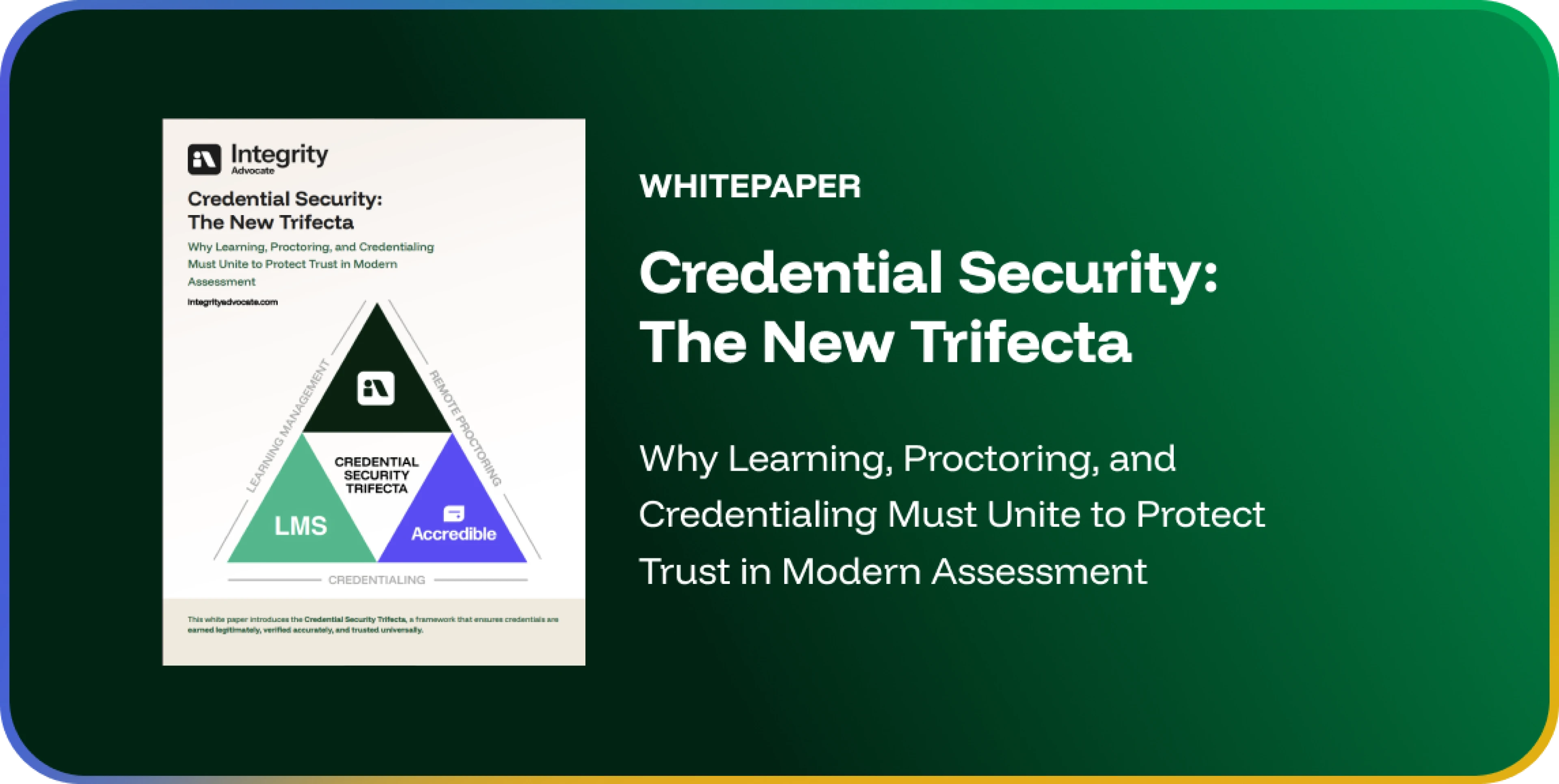
Credential integrity is the confidence that a credential truly represents what was earned. It means the right person completed the work, the assessment was conducted fairly, and the credential was issued based on verified performance. That confidence is built across identity verification, assessment oversight, credential issuance, and long-term validation.
As digital credentials become more visible, portable, and high-stakes, organizations are being asked a more important question: Can you defend how this credential was earned?
That question requires more than a proctoring solution. It requires a system.
In our latest whitepaper, The Credential Security Trifecta, we outline a practical framework for designing a defensible credential ecosystem, one that connects learning, verification, and issuance into a coherent chain of trust.
Credential Security: The New Trifecta
Why Learning, Proctoring, and Credentialing Must Unite to Protect Trust in Modern Assessment
The Shift From Exam Security to Credential Security
For years, assessment security focused primarily on preventing misconduct during testing. That remains important. But today’s risk environment has expanded.
AI-enabled misconduct, identity fraud, contract cheating, and synthetic digital documents have changed the landscape. At the same time, digital credentials are widely shared across LinkedIn profiles, employer systems, and workforce platforms. They are public representations of institutional trust.
And the stakes are higher than ever. In an AI-accelerated world, institutions must be able to answer a fundamental question: can we confidently verify who earned this credential — and whether it was earned fairly? When credentials influence hiring decisions, promotions, licensure, and professional standing, the consequences of getting it wrong are significant.
That means the integrity conversation must move beyond: “Was this test monitored?” to: “Is this credential defensible?”
Credential security is not just about detecting misconduct. It’s about ensuring that identity, performance, and issuance are connected in a way that can withstand scrutiny.
Why Fragmented Systems Create Risk
Most organizations operate across three separate layers:
- A learning management system where instruction and assessment occur.
- An integrity or proctoring solution that verifies identity and behavior.
- A credentialing platform that issues digital certificates or badges.
Each layer may function well independently. The risk emerges in the gaps between them. If these systems are not intentionally aligned, you may lack:
- A clear documentation trail from identity verification to issuance
- Audit-ready evidence of how integrity was upheld
- A consistent standard across programs
- Confidence that only verified outcomes result in credentials
That fragmentation makes defensibility harder when questions arise from employers, regulators, or internal leadership.
The Credential Security Trifecta Framework
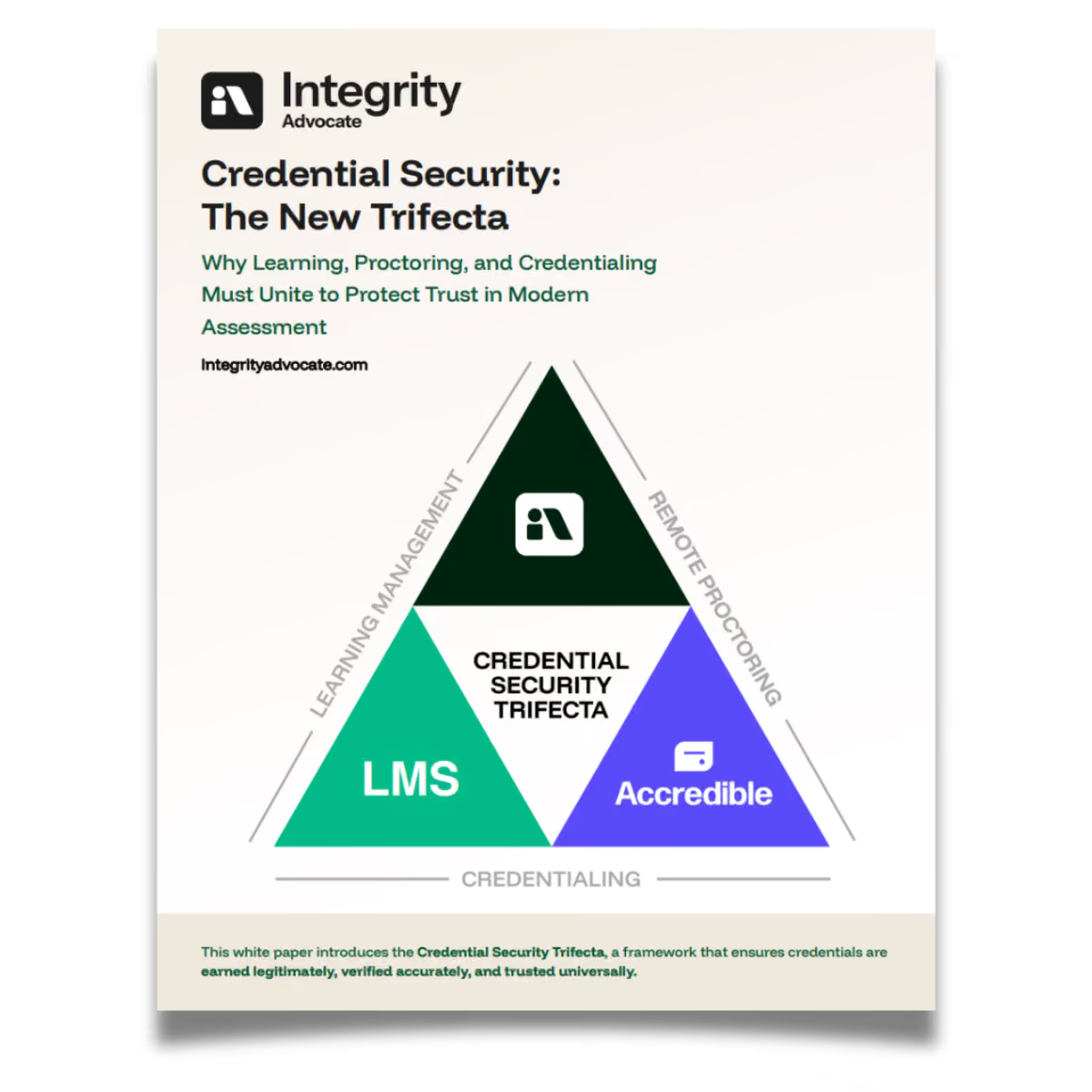
The whitepaper introduces the Credential Security Trifecta, a framework that connects three essential components into a unified architecture:
Learning & Assessment Infrastructure: Where learning is delivered and performance is measured.
Identity & Integrity Verification: Where identity is confirmed, assessment conduct is reviewed, and integrity decisions are documented to ensure performance is legitimate and defensible.
Secure Digital Credential Issuance: Where verified performance becomes a tamper-resistant, independently verifiable credential.
When these three components operate as an integrated system rather than isolated tools, they form a defensible chain of trust.
This shifts the posture from reactive security to intentional design.
What a Defensible Credential Ecosystem Looks Like
A defensible ecosystem does not rely on assumptions. It provides clarity. It enables leadership teams to answer, with confidence:
- How do we verify identity at scale?
- How do we document integrity decisions?
- How do we ensure credentials are only issued for verified performance?
- How do we validate credentials long after they are awarded?
These are governance questions as much as technical ones. They impact compliance, employer trust, learner confidence, and institutional reputation.
Designing for defensibility requires alignment across technology, process, and policy.
What You’ll Learn in the Whitepaper
The full whitepaper expands on:
- The evolving risk landscape impacting credential credibility
- Where organizations most commonly experience blind spots
- How to evaluate your current architecture
- Strategic questions leadership teams should be asking
- A practical model for implementing the Credential Security Trifecta
It is written for certification bodies, higher education leaders, workforce programs, and assessment teams responsible for protecting credential value.
If you are evaluating how your organization connects assessment integrity with credential issuance, this framework will provide clarity.
Download the whitepaper
Keep reading

Who We’re Certifying Matters: Why Assessment Security Must Evolve With the Credential Landscape
February 24, 2026
|
5
min read
Assessment security has expanded beyond preventing cheating to protecting the long-term credibility of every credential an organization issues. Remote and hybrid delivery, AI tools reshaping candidate behavior, rising employer scrutiny of credential validity, and the rapid expansion of digital credentialing are all converging to make this a strategic rather than operational question. This post examines why credential credibility now depends on assessment security design, what the risks of getting it wrong look like across higher education, professional certification, and workforce training, and why connected, integrated systems are the only approach that produces defensible outcomes at scale.

Who Is Liable When Proctoring Goes Wrong? Lessons From Global Legislation and Cases
May 2, 2024
|
5
min read
Courts and regulators across Canada, the EU, and the United States have consistently found that organizations deploying proctoring tools bear liability for how participant data is handled, not the software vendors they use. CASL, GDPR, BIPA, and the Cleveland State Fourth Amendment case all point to the same conclusion: the organization collecting data is the accountable party. This post examines each case and framework and explains what organizations need to do to reduce their exposure.

When AI Outsmarts Exams: Safeguarding the Value of Your Credentials
October 1, 2025
|
3
min read
GPT-4 has scored in the 90th percentile on the Bar Exam, 93% on the US Medical Licensing Exam Step 1, and outperformed average test-takers on the SAT, LSAT, and graduate-level law school exams. When AI can pass the same high-stakes exams certifying bodies have relied on for decades, the credibility of those credentials is at risk. This post examines what is at stake when AI can bypass traditional exam security, where legacy tools fall short, and what a hybrid AI plus human review approach looks like for certifying bodies that need to protect the value of their credentials without compromising the candidate experience.
Frequently asked questions
Find answers to the most commonly asked questions from our clients.
The Credential Security Trifecta is a framework from Integrity Advocate that connects three components of a defensible credential ecosystem: Learning & Assessment Infrastructure where performance is measured, Identity & Integrity Verification where identity is confirmed and integrity decisions are documented, and Secure Digital Credential Issuance where verified performance becomes a tamper-resistant, independently verifiable credential. Operating as one integrated system rather than isolated tools, these three components form a defensible chain of trust.
Assessment security historically focused on preventing misconduct during testing. That remains important, but AI-enabled misconduct, identity fraud, contract cheating, and synthetic digital documents have expanded the risk. Digital credentials are now widely shared across LinkedIn profiles, employer systems, and workforce platforms, making them public representations of institutional trust. The question institutions must answer has moved from "was this test monitored" to "is this credential defensible."
Most organizations run a learning management system, an integrity or proctoring solution, and a credentialing platform as three separate layers. Each may work well on its own, but if they are not intentionally aligned, organizations can lack a clear documentation trail from identity verification to issuance, audit-ready evidence of how integrity was upheld, a consistent standard across programs, and confidence that only verified outcomes result in credentials.
It is written for certification bodies, higher education leaders, workforce programs, and assessment teams responsible for protecting credential value, particularly organizations issuing credentials that influence hiring, promotion, licensure, or professional standing.
How to verify identity at scale, how to document integrity decisions, how to ensure credentials are only issued for verified performance, and how to validate credentials long after they are awarded. These are governance questions as much as technical ones, and they affect compliance, employer trust, learner confidence, and institutional reputation.