April 7, 2026
|
3
min read
What Defensible Assessment Looks Like in 2026
AI tools have changed what cheating looks like, and most proctoring systems were built for a different problem. This post covers why an automated flag alone can't defend an outcome, and what a defensible assessment record requires in 2026.

We talk to a lot of programs right now that are dealing with the same thing. AI tools have changed what cheating looks like, and most proctoring systems were built for a problem that’s no longer the only one on the table. The gap is showing up in appeals, in complaints, and in outcomes that are getting harder and harder to defend.
What’s actually happening out there
The classic image of cheating a second phone, a friend on the other side of the room, notes taped to a monitor is still real. But it’s not the conversation we’re having with most programs anymore. The harder stuff is subtler.
AI writing tools can produce a natural, well-reasoned answer in seconds. Paraphrasing tools can disguise lifted content well enough to pass similarity checks. And the behavioral signals that used to flag something suspicious eye movements, typing pace, browser switching don’t tell you much when the assistance is happening invisibly, in another tab or on another device entirely.
The problem isn’t that AI cheating is impossible to catch. It’s that catching it requires a level of context and judgment that an algorithm alone doesn’t have.
An algorithm can tell you something looked unusual. It can’t tell you what actually happened or whether it matters. That part still requires a person.
Why a flag without a human isn't enough anymore
Automated proctoring was designed to catch visible, definable behaviors tab switching, phone use, an unauthorized person on screen. For those cases, it works. But AI-assisted cheating often leaves no visible trace at all.
So when an automated system flags something in this environment, what it's actually telling you is: something here didn't fit the expected pattern. That's a starting point, not a conclusion. The problem is when programs treat it like one.
A wrongful finding based on an automated flag isn't just uncomfortable it can seriously damage a student's record or a professional's career. And when that decision gets challenged, "the system flagged it" isn't a defensible answer. You need a record of what actually happened and a human judgment behind the decision.
{{post-stat-highlight}}
What it actually takes to be defensible
Defensibility isn't really about technology. It's about being able to look anyone in the eye a student, a candidate, a regulator, a board member and explain clearly why a decision was made and what it was based on.
In this environment, that takes three things:
- Human review on every flag, before any decision goes out. Not as an appeal process. Before the outcome is issued.
- Reviewers who are looking at AI-use patterns specifically, not just traditional integrity signals, and who understand the difference between something suspicious and something definitively wrong.
- A complete session record identity verification, monitoring log, what was flagged, what the reviewer saw, what was decided ready to export the moment someone asks.
What actually changes with human review
One question to sit with
If an outcome from one of your proctored exams was challenged today by a student, a candidate, an employer, an accreditor what could you actually put in front of them? An automated flag, or a complete human-reviewed record of what happened and why?
For programs where the result genuinely matters, that's not a rhetorical question. It's the one worth answering before you need to.
We built Integrity Advocate around exactly this human review on every flagged session, a complete audit trail for every outcome, and the kind of defensibility that holds up when someone actually pushes back.
{{post-cta}}
73%
of higher ed students report using AI tools during coursework in 2024
40%
of proctoring flags in AI-heavy environments are estimated to be false positives
Keep reading
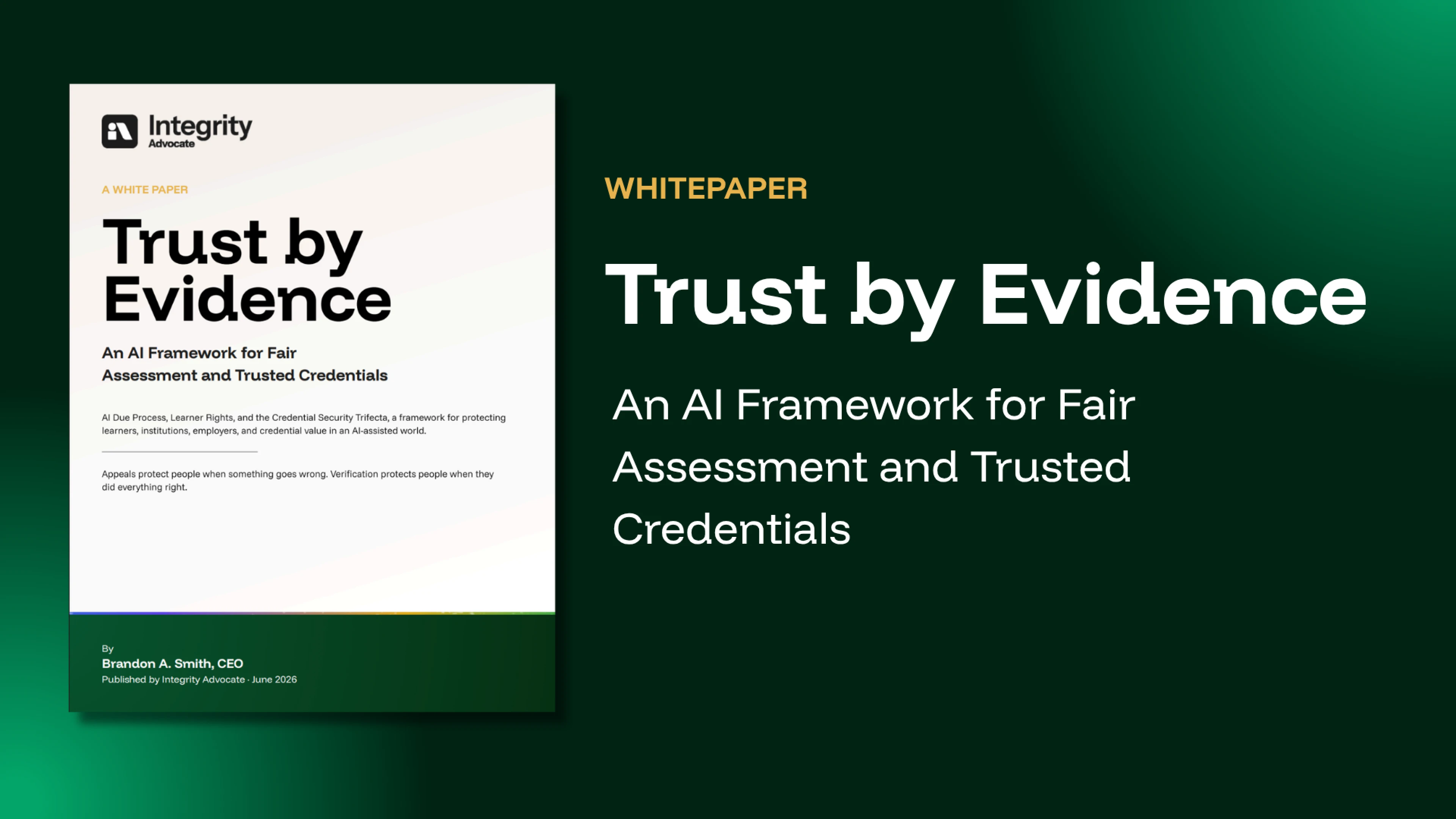
Trust by Evidence: A New Framework for Defensible AI Decisions
July 22, 2026
|
4
min read
Integrity Advocate has released a new whitepaper, Trust by Evidence, introducing a framework that connects AI due process, learner rights, and credential security into one model for defensible AI-assisted assessment. This post walks through what the framework covers, why AI adoption alone no longer settles the integrity question, and links to the full whitepaper download.

Case Study: How Alliance Safety Council Took High-Risk Training Remote Without Losing Legal Defensibility
February 24, 2025
|
3
min read
Alliance Safety Council (ASC) has spent over 60 years setting the standard for high-risk workforce training in petrochemical, power generation, and manufacturing, industries where compliance isn't optional. Their in-person, proctored training model relied on identity verification and close monitoring to serve as an impartial third-party administrator for clients. As demand for remote training grew, ASC needed a solution that could match that legal defensibility without the logistical headaches, or the technical barriers that most online proctoring tools introduced. Integrity Advocate became that partner.
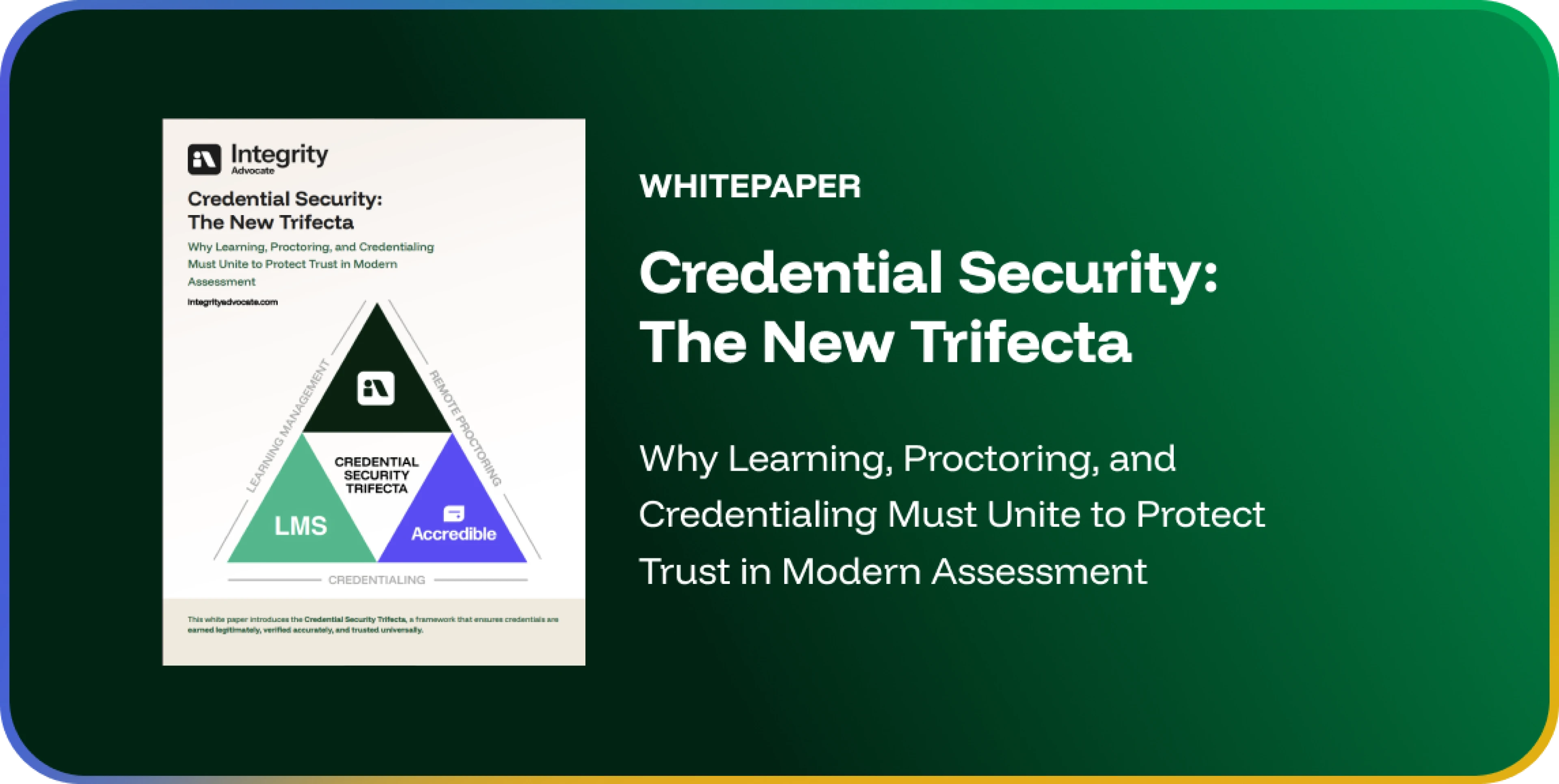
The Credential Security Trifecta: Designing a Defensible Credential Ecosystem
February 25, 2026
|
3
min read
Credential integrity depends on more than a single tool. It requires identity verification, assessment oversight, credential issuance, and long-term validation to operate as one connected system. As digital credentials become more visible and portable across LinkedIn profiles and employer systems, organizations need to be able to answer a harder question than "was this test monitored": is this credential defensible? This post introduces the Credential Security Trifecta, a framework connecting Learning & Assessment Infrastructure, Identity & Integrity Verification, and Secure Digital Credential Issuance into a unified chain of trust, and points to the full whitepaper for the risk landscape, common blind spots, and an implementation model.
Frequently asked questions
Find answers to the most commonly asked questions from our clients.
It can flag behavior that doesn't match expected patterns — unusual typing rhythms, browser activity, or answer construction that looks atypical. But detecting a flag is different from determining what happened. AI-assisted cheating often leaves no visible behavioral trace at all, which is exactly why human review matters. A trained reviewer can assess what the flag actually means in context before any decision is made.
Without human review, a wrongful flag can become a wrongful outcome — and that outcome lands on a student's record or a professional's career. When it gets challenged, "the system flagged it" isn't a defense. Programs that use automated-only proctoring often find themselves without the documentation needed to justify the decision or dismiss the complaint.
At Integrity Advocate, every session that generates a flag is reviewed by a trained human reviewer before any outcome is issued. The reviewer looks at the full session context, assesses what actually happened, and documents their assessment. That record — the flag, the context, the judgment — becomes the audit trail attached to the outcome. It's what makes the decision defensible if anyone ever asks.